



A golf trip in Silicon Valley reveals some answers good and scary about the future
by curtis gillespie
Driving into San Francisco from the airport recently, I passed a billboardthat said, “Welcome to AI country. Population: Everyone.” That seemed to capture things well.
The next day, I was at the magnificent Cal Club, momentarily forgetting how AI had become an inescapable part of daily life. I found myself in a bad spot on the 10th hole, facing 200 yards uphill from chewy rough, a shot that also required a fade around a troop of Monterey Cypress. My strategic process proceeded as per usual, which can be summed up as, close eyes and swing.
But then I remembered, Wait, must consult the algorithms. In my mission to better understand golf’s convergence with artificial intelligence, I was getting to try some products before they hit the market. The Arccos AI smart laser looks like any range finder except it pairs with your phone and a tracking device the size of an earbuds case you keep in your pocket. Together, these tools gathered and assessed available data points—distance, wind, gusts, slope, elevation, temperature, humidity, hole location, green shape, bunkering and somewhat unnervingly, my anticipated performance. The app on my phone advised a wedge-out of 90 yards to leave a third of 110 yards, showing precisely where it wanted me to aim on a map of the hole and with what club. This advice was intended to give me an outside chance at a par, probably make bogey. Me being me, I reached for a 4-iron.
Ten minutes later, walking off the green with a triple, I reflected on how AI’s future impact on golf might be bottomlessly complex, but how in another sense, it all comes down to one basic question: Given that AI stands to influence practically every component of the game, is this good or bad?
The term AI is a broad tent under which many different processes take place. A useful analogy is to think of AI as a shopping mall. The AI mall has a major anchor tenant, which in this case is machine learning, the brute-force computing tool that identifies patterns and relationships through data comparison. Then there are smaller shops for specific products, such as large language models (LLMs), which are very much behind the public AI boom in that they have facilitated mass access to AI via the approximation of plain speech. Other shops include the generative AI store, where you can “generate” things that didn’t previously exist (“Claude, please take all these individual expenses and create a single new monthly household budget spreadsheet.”). There is also the robotics-gadget store, the neural network store for facial recognition, and so on. Every outlet in the AI mall is offering some kind of simulated intelligence product, but machine learning makes up 80 to 90 percent of retail volume. Just as a normal mall needs a constant flow of foot traffic to survive, the AI mall must endlessly harvest data to double as both foot traffic and inventory.
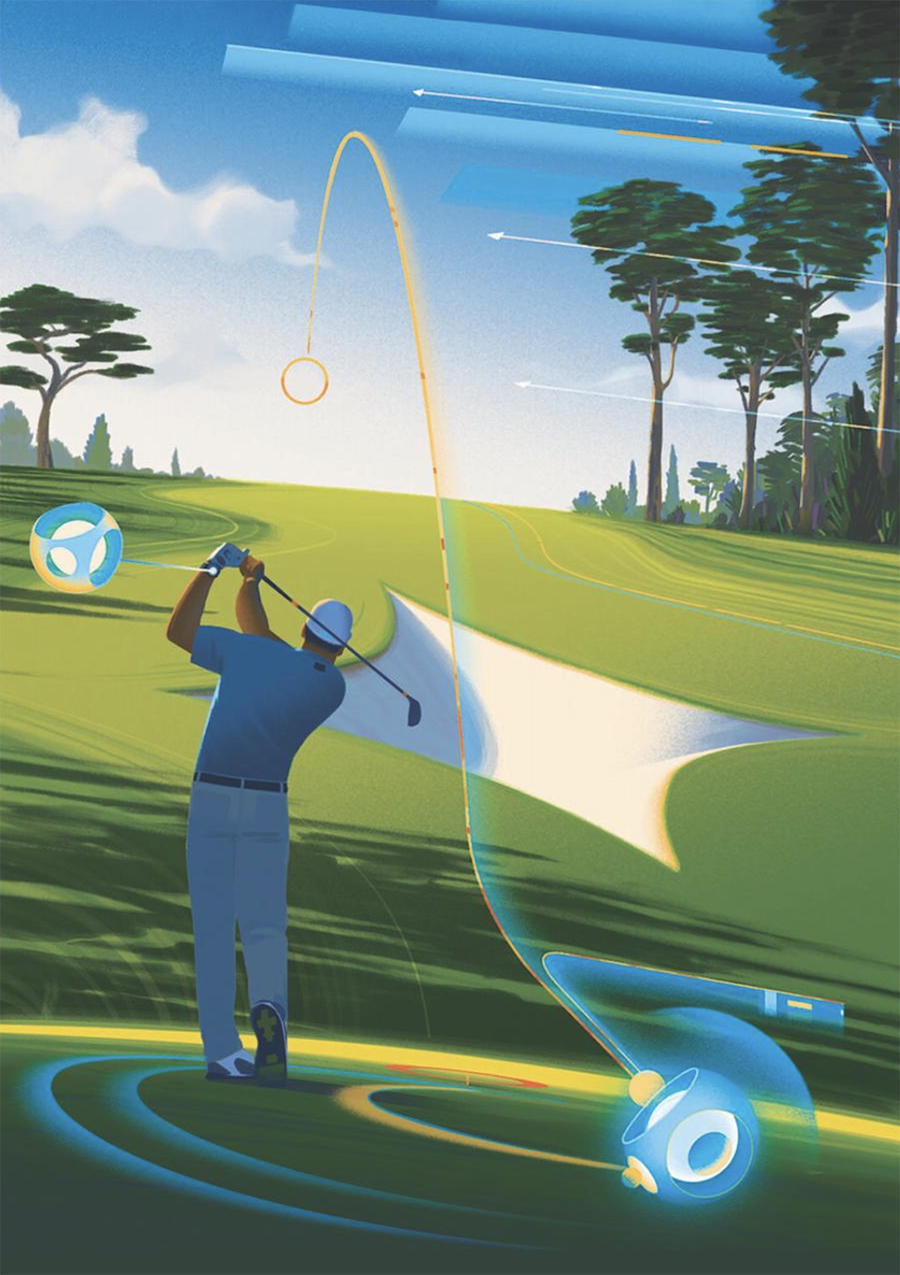
Wander down a spur aisle of the AI mall and you’ll also find the golf shop. It’s not the biggest, but we golfers do love gadgets and tech. The AI golf shop has products for swing analysis, mental-game assistance and on-course strategy. AI is also being used in club design, agronomy, tournament organization and custom fitting. Some of the more accessible DIY applications include golfers using it to plan efficient golf travel itineraries or settle bets with onerous math.
Mike Zisman, founder and CEO of Golf Genius, adds that “Even if to the public AI is relatively novel, it’s actually been evolving for decades.” It’s also important to remember, he says, that amidst so much talk of Artificial General Intelligence (AGI) one day taking over humanity, AI today is mostly one thing: our anchor tenant, machine learning. AI remains primarily a marriage between math and mind-boggling amounts of computing power enabled by even more mind-boggling amounts of electricity. Hence, data centers so vast condensation from the water used to cool the machines generates indoor rain. We are deploying computing power ceaselessly to hoover up, assess and compare data to predict and then provide answers to our questions.
This simulates human intelligence. Will it help us become better golfers?
COURSE MANAGEMENT
While in the Bay Area, I also played Lake Merced Golf Club, which has been recently restored, and there was a certain cognitive dissonance in talking about AI in such natural surroundings. I mentioned to my playing partner, David Lee-Tolley, the VP of Product for Arccos, how it all felt a bit mechanistic, a little cold. Where, I wondered, do feel, intuition and experience fit into all this?
“To me, the relationship between AI and feel is complementary,” Lee-Tolley said. His opinion was that AI might help me discover, for instance, that I’m better from 90 yards than 50 yards, and so I might replicate my 90-yard process with those shorter shots. Golfers who took the time to capture data in the past (remember the days of pacing off yardages?) and who were willing to do their own math and analysis might have uncovered similar insights, but AI can recommend strategies for the laziest among us in seconds.
There’s cognitive bias in all of us, says Arccos CEO and founder Sal Syed, in the way most people believe they are above average drivers of a vehicle. “We are trying to have people make shot selections based on their average shot, not their one-in-a-million shot.”
Both Matthew Fitzpatrick and Edoardo Molinari are Arccos ambassadors who use its product to plot out course strategies based on probabilities, so there’s an argument to be made that AI helped the Euros win the Ryder Cup at Bethpage. As with most tech, it gets easier the more you use it, and as with many AI products, the more you use it, the more it “learns” about you. This happens through a twin-track machine-learning process of analyzing your individual results while also clustering you with other golfers who have similar results so that it can make increasingly informed recommendations about what you and your level of player ought to do in any given situation.
Golfshot, which is owned by Golf Genius, gathers your shot data through the Apple watch. John Hawley, the chief technology officer of Golfshot, says that the collection and interpretation of data might seem impressive now, but where AI is going to shine in the future will be when refinements allow for verbal dialogue between player and app. “One day there will be a true on-course caddie AI app,” says Hawley, “an app that assesses all the data and then literally has a strategic conversation with you.”
That feature isn’t here yet. LLMs or SLMs can have conversations, but it’s taking the golf industry time to “create the right experience,” says Hawley. In other words, yes, there is sufficient tech right now to create an app that could offer golfing counsel via conversation in the mid-round moment. But you’d have to be connected to the internet, it would have to go through an app, it would need extremely precise inputs from the golfer, it would have to be concise and pitched to the linguistic level of the user, and it would have to be seamless in terms of timing and access. As a golfer, you don’t want to have to fiddle with all that before every shot. Golf already takes too long. Not to mention, an AI caddie app is currently against the rules, strictly speaking.
“We can’t ask people to pause playing golf to become immersed in an application,” Hawley says. “The interactions need to be easily accessed, unintrusive and not interrupt the golfer’s natural flow. That can take a lot of time to get right, but that’s where the experimentation is right now. It’s coming.”
GOLF COURSES BUILT BY AI?
The most intriguing way AI can assist in golf course design is with routings, the process by which architects arrange 18 holes around a given property. In theory, there are uncountable combinations of holes, lengths, orientations and ways to use a given piece of land. AI has the power to analyze a topographical map and quickly produce the most optimal routing based on specific client desires (overall yardages and par, returning nines, etc.), saving architects days or weeks playing with configurations and trudging through the brush.
To date, however, AI is not proficient at it. There is no vast database of golf course routings and topographical maps for it to learn from, and no design firm has spent the necessary time feeding the written theory and instructions necessary for it to be useful.
This is what architect David Kahn, of Jackson Kahn Design, has discovered by experimenting with available AI systems. “I’ve fed it base maps with very detailed rules about how to arrange a golf course to see if it could do a stick-figure routing, and it falls flat on its face,” he says. “It’s not there yet. But if somebody dedicated a month to feeding existing routings and topo maps and refining the instructions, it would work, and it could be objectively great at it.”
From that point, AI would be only a few small steps from being capable of autonomously conceptualizing the blueprints for an entire course, tabulating grading plans, positioning bunkers and tees, and arranging hazards and contours. This leads to a larger question: Would golfers want to play a course that’s designed by computer algorithms, particularly at a time when an architect’s name carries cachet akin to a movie director or painter? Tom Doak, who has utilized advanced technologies to recreate holes in exacting detail at The Lido at Sand Valley and elsewhere, doesn’t think so, at least not yet.
“I don’t know why ‘AI-designed’ golf courses would be sought after by golfers,” he says.
“Surely, the main attraction for developers would be that they didn’t have to pay the AI as much as they pay me,” Doak says. “To me, one of the appeals of golf is that it gets us away from the phone and computer to spend quality time outdoors with our friends. I get the same enjoyment with my associates the way we build our golf courses, and I wouldn’t want to trade that in for an AI system. Personally, I’d prefer that AI design stick to simulator courses, but I’m sure it won’t, and someone out there will try to come up with a program that is better at design than anyone alive. I wish them nothing but the worst of luck.”

Where AI can currently help is in the role of super-assistant, completing existing tasks more efficiently. It used to take Kahn and partner Tim Jackson for or five hours to create presentation-worthy renderings of proposed holes for clients. “Now I can do an unpolished draft in 30 minutes that expresses our intent and creative process, and feed that into AI that will spit out a beautiful, fully articulated version in ten seconds,” Kahn says. The information in the drawing is still human created, but AI is finishing the job. “That part is already here,” Kahn says. What comes next will be determined by how eagerly architects embrace AI as an asset or whether they view it as a threat.
THE MENTAL GAME
Of course, all the AI strategy in the world won’t help much if you struggle with your state of mind. Deborah Graham is a sport psychologist who has worked with many pros, and she believes AI is set to have a big impact.
“I can see so many ways AI could help golfers,” she says, citing areas such as personalized mental-skill tools, tracking mental-performance patterns, real-time emotional health consults and access to an AI mental coach 24/7. Most golfers don’t use a sport psychologist because it can be expensive and feel like a “serious” player thing.
But if it’s cheaper and there’s no self-judgment, a 16-handicapper might access personalized mental training as readily as a pro. Still, there will be risks, primarily that we could develop too much trust in something that, no matter how friendly it sounds, is still just an algorithm. “AI might misinterpret cultural differences, sarcasm, context, and either scare people unnecessarily or miss serious issues, like clinical depression masked as post-loss emotion,” Graham warns.
Making myself the guinea pig, before and after several rounds I used Mind Caddie, a sport-psychology app featuring “AI Karl,” which is based on the work of Karl Morris, the European mental-game coach who has worked with pros such as Louis Oosthuizen. I fed some thoughts and feelings into AI Karl as written text, concerns about my dealing with pressure and losing focus. For instance, I told AI Karl, “I find that I really struggle with success. Whenever I am four or five holes from finishing off a great round, I start waiting for the disaster to happen—and it always does.” The responses, generated by a combination of machine learning and an LLM, came back quickly as text advice that was certainly relevant to my questions, but the suggestions (keep a journal, do breathing exercises) felt rather boilerplate.
YOUR AI MENTAL COACH WILL LISTEN TO WHAT YOU ARE TELLING IT BUT WILL ALSO BE SCANNING YOUR PHYSIOLOGICAL DATA THROUGH A WEARABLE DEVICE.
I must say it was nice to finally find a companion willing to enthusiastically listen to narrative recreations of my rounds shot by shot. Therein lies one of the true dangers of AI: Simulated empathy still touches something inside of us.
Graham believes AI will become a powerful tool to complement—but never replace—human psychologists. The field will likely shift, she feels, toward psychologists becoming “AI-augmented experts” who can take information about their clients that AI has gathered and interpret what it means, override it when necessary and offer a human reflection.
Of course, the complementary, AI-augmented human future is sort of a blanket assessment these days for just about any industry that uses AI, which means all of them. AI will “augment” your banking skills, your traveling plans, your recipe box, your family dynamics—and that’s just what we can see. What we don’t see is that every piece of public or private information we feed into an AI program might assist us, but it’s also being used by AI to make itself better at simulating and reflecting us. AI is a constantly evolving mirror that looks more deeply into us every time we look into it.
It’s also entirely possible that one day, sooner rather than later, your AI mental coach will listen to what you are telling it but will also be scanning your physiological data through a wearable device. Your blood pressure, heart rate, body temperature and sleep quality might be indicating that you are feeling tense, under pressure, tired, frightened or overstimulated. AI can recommend a response to this information, but, says Graham, “only a human sport psychologist could come in and say, OK, what is the underlying issue causing all this. Some players have tremendous self-awareness, but many don’t. AI can’t do that exploration, and it can’t provide genuine empathy.”
Well, not yet anyway.
SWING TIPS
AI assistance with strategy and mental game are potentially valuable, but you still must swing the club. I tested some AI swing analysis tools at the Stanford Golf Course, which winds through the deep valleys and high hills of the Santa Cruz mountains. At certain points you can see the ochre-tiled roofs of the campus buildings and the spires of downtown San Francisco.
Golf Digest has a business relationship with Mustard, so I tried its app first. Mustard started as an athlete-analysis tool for baseball pitchers five years ago, co-founded by former MLB player and pitching coach Tom House. The company spent two years developing its golf app with help from investors Justin Rose and Mark Blackburn—voted No 1. on Golf Digest’s 50 Best Teachers in America—and other experts in motion analysis and coaching. I filmed one swing video and in about a minute, got an assessment of my swing with “scores” in various areas, not raw data. The app uses something called computer-vision technology to locate all the major joints in the body and track their movement. Then, it taps AI to compare the data against tens of thousands of 3-D swing models. Most of the advice it offered on how I could improve seemed manageable, or more manageable than finding a teacher.
“Every great coach has frameworks they use to analyze players,” says Mustard co-founder and CEO Rocky Collis. “We spent thousands of hours with golf’s best coaches and turned their frameworks into algorithms, so that Mustard personalizes instruction the way a top coach like Mark Blackburn would.”
WHERE AI IS GOING TO SHINE IN THE FUTURE WILL BE WHEN REFINEMENTS ALLOW FOR VERBAL DIALOGUE BETWEEN PLAYER AND APP.
I also tried Sportsbox AI, where, similarly, you upload a smartphone video of your swing within an app and get results in about a minute. The company was founded in 2020 as a breakaway from Voicebox, the company that provided natural voice recognition for Samsung. Jeehae Lee, Sportsbox CEO, played on the LPGA tour and has an MBA from Wharton. “It’s not about what a good swing for Rory is,” Lee says. “We want to find the patterns to tell a person what a good swing is for them.”
Lee may not be telling people how to swing like Rory, but she is telling Bryson how to swing like Bryson. An ambassador for the company, DeChambeau used Sportsbox during his 2024 U.S. Open win at Pinehurst. He worked with Lee directly to decode how his swing angles were off at some microscopic level.
“We’ve been doing this with Bryson before every major. To me, this is the future. Why, as an instructor, would you ever again just use your eyeballs?” Lee says.
Speaking of instructors and eyeballs, Sean Foley had both of his keenly focused when he signed on the dotted line to invest in Sportsbox AI. Foley is one of the more well-known instructors in the game, but he’s also something of a free thinker. Want to know why you are pulling the ball with your 9-iron only? Foley can tell you, but he might also add things like, “How is AI ever going to know that to take the next step, a pro like Michael Kim is going to have to read a specific chapter of Nelson Mandela’s Long Walk of Freedom?
In Foley’s opinion the golf swing is usually poorly taught, so AI stands to help. “We never had the ability to measure what was actually going on. Now we do. AI allows golf teachers to get a lot better a lot more quickly. You’re not guessing.”
I asked Foley if he thinks there’s any danger that AI will one day make his job irrelevant. Never, he said. AI is a great tool, but “AI can’t see what’s needed beyond the mechanics. It’s going to be about how we use it, and it’s never going to make reps unnecessary.”

YOUR GRANDCHILDREN’S GOLF
What of the philosophical and ethical considerations of golf mixed with AI? Don Harrison thinks about these things, partly because he’s a single-digit-handicap golfer in the Palo Alto area, but also because he happens to be Google’s president of global partnerships and corporate development.
“I don’t lose sleep over AI replacing human intelligence,” he said from the Googleplex in Mountain View, which is a 20-minute drive from the Stanford Golf Course. “Whenever something has limited data, like golf, then AI absolutely has the ability to absorb that data into a single model. It will optimize the swing for any kind of body or style. It will use its own predictive technology in a way that’s significantly better. It will be teaching and helping people in a progressive, bespoke manner.”
The most exciting developments, Harrison says, will come when AI can look at the sum of your data and deliver a complete, ongoing and continuously adjustable plan in conversation. Too much of what we’re seeing right now, he says, still boils down to having enough computing power to analyze the data.
“No one has yet built a model I’ve seen using small language models,” he says. A large language model (LLM) scans the entire internet universe when asked a question, whereas a small language model (SLM) is a simulated conversation operating exclusively from the knowledge base of a highly specific sector or process, such as golf. “My guess is that companies with significant golf products are starting to experiment with small models. But you haven’t quite seen an example yet of a pure language model providing teaching or guidance that’s going to help you play better golf.”
In other words, one day soon, you should be able to open your SLM caddie/swing instructor/mental coach app, upload video, get swing analysis, review strategy, assess your mental and physiological state, all geared toward you alone, and it will all unfold conversationally through a wearable device. Still, AI is ultimately going to be just another tool golfers have at their disposal. If you shoot in the 80s, never practice, have erratic focus and down a couple of beers before the turn, AI is not going to transform you into a 2-handicap.
Although if you are this person, I’m pretty sure I’d enjoy playing golf with you.
Part of golf’s allure, of course, is that it’s impossible to master. Perhaps AI will sand away some of our inconsistencies, even if it’s those inconsistencies that make us human. Regardless, AI is coming, hard, whether the sport is ready or not. I reached out to the Rules Committees of both the USGA and the R&A. I was curious about the kinds of conversations they are having around AI usage in competition and training. How might it be restricted with juniors? Could AI have useful applications for rulings in tournaments, such as where to take drops? Both organizations declined comment.
When I left the Bay Area, I passed the same AI Country billboard on my way to the airport. Heading south, the other side of the billboard said, simply, “Make something people love.” Naturally, it made me think about what we love about golf.
In that context, perhaps it’s helpful to think of other big changes the game has gone through, with equipment advances and video teaching analysis arguably two of the more consequential in the past few decades. Most of us hit the ball farther than we used to. There certainly aren’t many Miller Barber swings left on tour—or Miller Barber bodies, for that matter.
Does that mean golf, in sum and for each of us, is better than it was 30 years ago? Is golf something we love or a math problem to be solved? Or is it a combination of two dissimilar things that can live in harmony? I want to shoot lower scores, but I love my annual golf trip with my buddies. I want to hit longer drives, but I love parsing out different ways of playing 60-yard bump-and-run shots. I want to play better tournament golf, but I loved playing with my dad when I was a kid and neither of us were that good. I use the latest drivers and play with top-end golf balls.
I have taken lessons in which AI tools identified swing flaws that were corrected and made me better. I enjoy watching Trackman Rory duke it out with AI Bryson. But better equipment, better teaching, better swing analysis and better pros have not made me love golf more than I did when I was 18 years old.
Should I be lucky enough to have grandchildren one day, they will probably be golfing with AI tools we can’t even dream of, or, more likely, tools that AI itself has generated. In every sector in which AI is impacting how we play the game—in strategy, in the mental game, in swing analysis—experts felt AI would slot in as a complementary technology, not one designed to replace humans. Though how can any of us know for certain?
In the end, your most important relationship to the game won’t be about whether you use AI or don’t use AI. It’ll be about remembering where the soul of golf resides, no matter what tools you’re using.
Here’s a hint: It’s not in the data.
YOUR NEXT CUSTOM FITTING MIGHT NOT REQUIRE A SINGLE SWING
A century ago, Bobby Jones was making a backup for his legendary Jeanie Deans driver. He sorted through “5,000 pieces of first-grade hickory to find four shafts” that were close. The process was an elaborate exercise of “guess and check.” Fitting golfers to clubs has changed immensely since then, and yet it hasn’t. It’s still a tentative dance between what the experts think they know and what the golfers think they feel.
The most visible presence of the future state is Club Champion, the world powerhouse in elite custom-fitting. Club Champion founder Nick Sherburne first brought artificial intelligence to the company’s 160-store network five years ago, and now its AI-driven Co-Pilot system can produce recommendations in as little as 10 swings. It has fundamentally shifted the clubfitting dynamic from guess and check to objective digital facts. With tens of thousands of permutations on its wall of clubheads and components, no human fitter could adequately ever process all of a customer’s potential specifications. Now, not only does the human fitter not have to know everything, he or she gets smarter with every other fitter’s findings. Sherburne literally hits a button every week to update the software and make it smarter for every fit at every store.
“At first, the new fitters loved it because it made them smarter quicker,” Sherburne says, “but when the old guard would see it recommend something unconventional, they would say, ‘No way, that’s crazy.’ Of course, what’s happening is that somebody somewhere in this organization was fitting a golfer like that, or else it wouldn’t spit it out. But nine times out of 10 when we try it, it’s dead-on.” Sherburne said the company’s fitting recommendations cover a broader spread than in years past, a direct result of a system that is free from the typical biases that human fitters naturally develop in managing a wildly diverse system of potential solutions. It’s something only AI could reasonably navigate.
You can type your launch conditions into a new software package called Eldrick and get instant club and shaft recommendations as part of a new app developed by long-time nationally regarded clubfitters Dan Sueltz and Eric Touchet. Any golfer can have an online session with Anthropic’s AI chatbot Claude and get very detailed recommendations about the best new driver based on how you describe your game. The limitations: AI only really knows what’s already out there, including misconceptions from YouTube influencers and Reddit posts.
There remains a persistent problem with theory-based clubfitting: The golfer is an inconsistent, perhaps even unreliable witness. Perhaps most frustratingly, AI has not developed a handle on how different golfers perceive performance, particularly feel. Bobby Jones knew the right shaft by its specific heft in his well-trained fingers, but why one golfer responds to the flex profile of one shaft or the sound of this driver hasn’t been completely digitized, only approximated and generalized for the overall golfer population. For the brief present, why you like something seems beyond the realm of 0s and 1s. Understanding the right club for the right golfer remains an art form, just as it was for fitters a century ago.
Give Sherburne and his team another six months, maybe less. “We’re probably 90 percent of the way there, but that’s where it gets difficult. The cool part? It’s learning.
